In the intensely competitive arena of modern pro-level oversteer competition, podium finishes is far more than solely a product of sheer torque or driver bravado. Conversely, it is now a intricate discipline which necessitates a painstaking fusion of selecting a proven vehicle platform, outfitting it with the most precise competition hardware, and, most essentially, grasping its real-time behavior on the course through sophisticated drift telemetry software. This definitive handbook will serve as your master plan starting from the initial concept of a competition vehicle right through to the last telemetry-optimized tweaks that transform a powerful machine into a repeatable podium finisher. We will delve deep into the art and science of chassis dynamics adjustment, illustrating how a state-of-the-art suspension tuning tool like GripDial removes approximation and provides unparalleled clarity into your chassis's real-world performance.
The bedrock of any great drift machine is, indisputably, the platform itself. Several cars have achieved iconic reputation within the global sliding community due to their built-in handling characteristics, robust design, and the enormous ecosystem of specialist components available. Picking the optimal platform is the primary and most important choice a driver will make. To illustrate, the BMW's E36 3 Series is universally acknowledged as one of the best all-around drift platforms of history. Its excellent balanced front-to-rear weight, coupled with a rear-wheel-drive setup and bulletproof inline-six engines, creates a platform that is at once accessible for novices and incredibly competitive in the possession of a pro driver. The evolution of this lineage, the BMW E46 platform, refines these qualities with a increasingly refined frame, broader wheel track for greater stability, and even more steering angle straight from the OEM. Another dominant option in the professional scene is the Corvette C6.
This American track weapon brings a particular set of strengths to the sideways sport, such as a low-mass aluminium structure, a backwards-positioned gearbox and differential unit that aids in an excellent front-to-rear mass ratio, and the colossal thrust of a powerful LS V8 motor. This blend renders it an complete force on track, designed of starting and maintaining continuous angles with seemingly minimal application of acceleration. For drivers seeking remarkable value, the Nissan 350Z rises above as a prime choice. It comes from the factory with a robust chassis, a competent factory LSD, and the free-revving VQ35DE powerplant that provides plenty of power and torque for learning and progressing in the sport. Its successor, the Nissan Z34, presents more advancements in chassis stiffness, handling precision, and outright engine output, cementing its status as a popular selection among serious competitors. Additional historic vehicles that deserve consideration are the agile Wankel-engined FC generation RX-7, the most popular Nissan S13 240SX, the V8-powered Ford Mustang SN95, the electronic-equipped BMW E90, and the tiny yet unbelievably engaging and instructive Mazda Miata. All of these cars offers a different set of traits, difficulties, and capabilities, but they all have in common the core components necessary to serve as a competitive drift car.
However, picking the right platform is only the beginning. To unlock the complete capability of any of these machines, substantial upgrades to the steering system and damping and springing systems are completely non-negotiable. This is where the world of performance tuning components becomes critical importance. The one most impactful upgrade for a dedicated drift machine is the integration of a drift-spec angle modification kit. These advanced systems, such as those manufactured by specialist companies like specialist manufacturers, are created to dramatically increase the vehicle's available turning lock. A standard production vehicle is highly limited in how far its front wheels can turn, a design compromise for daily driving. In drifting, conversely, maximum steering input is frequently necessary to catch and maintain a angle. An modification kit replaces the factory uprights, linkages, and often control arms with parts that enable the steered wheels to attain steering lock beyond 70 or even 80 degrees, as opposed to a average OEM limit of around 40 to 50 °.
This immensely greater capability offers the driver with significantly enhanced authority during a angle, allowing it to be considerably simpler to begin a slide, maintain it through a extended turn, and change seamlessly from one angle to the other. The improvement in handling is truly revolutionary. Coupled with a correctly specified angle kit is the just as vital enhancement to the vehicle's damping system. Generic or including high-end road dampers are generally not intended for the particular and extreme demands of competitive oversteer. A drift-spec pair of adjustable dampers is paramount. These engineered dampers incorporate specific piston tuning and spring strength that are designed for the violent weight transfer that is typical of sliding. When a driver starts a drift, the car's weight is thrown forcefully to the outside of the turn. Optimal competition suspension handle this transfer in a controllable fashion, permitting the chassis to settle promptly and offering the pilot accurate response through the steering wheel and cockpit. They additionally enable exact adjustment of ground clearance, shock absorber stiffness, and cross-weight, which are all key aspects of dialing in the vehicle's behavior to a given track or competition style. Together, a precision-engineered drift angle kit and a expertly chosen set of performance adjustable dampers constitute the core hardware cornerstone upon which all subsequent refinement is constructed.
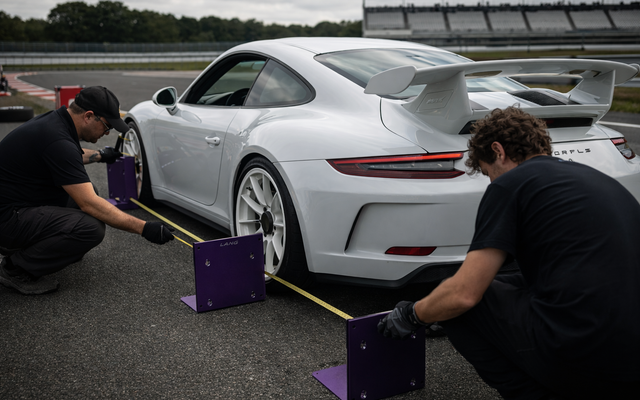
Once the core parts is in place, the next vital stage in the development is the meticulous tuning of the vehicle's suspension geometry. This is the domain of car suspension tuning, a methodology that can appear daunting to the newcomer but is, in reality, the secret to turning a assembly of fast components into a unified and predictable machine. The most debated element of suspension geometry for oversteer is undoubtedly camber angle. Camber angle is the tilt of the rim in relation to the perfectly straight axis when observed from the forward of the chassis. If the top edge of the wheel is leaning towards the car, this is known as camber-in. For drifting, an inward tilt on the front axle wheels is generally used and is regarded as essential. The purpose is deeply related to physics.
When a chassis is turning at limit angles, the frame rolls toward the external of the turn. This lean causes the outer front tire to lose its ideal contact patch with the tarmac. By adding inward lean, the tire is pre-tilted to account for this roll. As the car leans into the turn, the outside front tire gains a better contact patch against the road surface, increasing its grip at the critical point when it is most required for control. Commonly, front adjustments for a dedicated sliding vehicle fall between approximately -3 degrees to as extreme as -5 degrees or even beyond, based on the parameters of the car geometry, tire type, and driver preference. The rear axle tires also utilize negative camber, but the settings are generally more conservative and more nuanced than the front. Overly aggressive inward lean at the back can cause the vehicle to extremely loose and difficult to manage on throttle application, as it shrinks the effective grip area of the powered tires during linear throttle application. Therefore, rear axle camber settings are often in the ballpark of -1 degree to -3 degrees, finding a careful equilibrium between providing sufficient lateral bite to aid in initiating and maintaining the slide while still maintaining effective traction for acceleration the corner. camber angle is merely one element of the broader tuning picture, which additionally involves toe, caster, and steer correction correction.
Toe setting refers to the direction of the tires as seen from above. Inward toe means the front edges of the tires are closer together than the rear edges, while toe-out means the opposite. For sliding, a modest amount of front toe out is frequently used to sharpen the initial directional feel, making the car feel more responsive and ready to start a oversteer moment. Rear axle toe is generally set to zero or a extremely slight amount of inward toe to promote stability under acceleration. self-centering is the forward or aft inclination of the steering axis when observed from the side of the car. More caster angle improves steering feel and stability stability, and it also increases camber effect during turning, which is very advantageous. Setting these parameters is a intricate interaction where a adjustment to a single setting can and will impact the remaining parameters. The old-school approach for tuning a car's alignment for competition has historically been a time-consuming affair of guesswork and adjustment. A tuner or engineering group would make a modification based on a hunch, run the vehicle on track, depend on the operator's individual feel and feedback, and then make a further adjustment. This cycle would repeat time after time until the vehicle felt "acceptable" or the scheduled track period was exhausted. This system is not only incredibly wasteful in terms of hours and costs, but it is also inherently inaccurate.
Pilot feel is a famously inconsistent data source, influenced by many elements such as fatigue, varying track conditions, weather, and just the mood of the operator on that particular session. What feels "tail-happy" on one run might feel "understeery" on the subsequent lap, resulting in confusing data and frustrating tweaks. This long-standing limitation in chassis setup is precisely where contemporary technology has intervened to transform the process.
The advent and adoption of specialized drift telemetry software has ushered in a new age for tuning and perfecting competitive drift machines. This new generation of platforms, represented by groundbreaking systems like modern telemetry hardware, function by physically recording the real-time dynamic performance of the vehicle as it is operated on the course. In contrast to using personal feel, these systems gather objective data on essential variables such as damper compression and extension, wheel speed, acceleration forces, steering angle, and accelerator and brake pedal position. This acquired telemetry is then interpreted by sophisticated applications that can plot and analyze the metrics in a clear manner. For the very first time, drivers and teams can observe precisely what the chassis is doing at each point of a lap. This capability transforms the entire alignment optimization procedure. Consider the specific challenge of dialing in the front axle negative camber for a specific chassis. Instead of making a change from -3 degrees to -3.5 degrees and then suspension engineering running many runs to try and "sense" a difference, a suspension tuning tool can provide real-time and definitive data. The software can show in a chart how the wheel's grip is behaving during the key moments of a slide: initiation, holding the angle, and changing direction. It can show if the current value is enabling the outside front tire to achieve ideal grip or if the compound is working inefficiently on its outside edge.
The system can after analysis provide data-driven advice for change. Perhaps the telemetry reveals that the outside front tire is still overworking its edge at -3.5 degrees of camber, indicating that even more angle, say -4 degrees, might be advantageous. Conversely, the information might show that the tread is not reaching temperature or that the inside shoulder is degrading excessively, which could indicate that there is too much inward lean and a slight decrease back to -3.2 degrees would be more ideal. This standard of accuracy and practical insight was completely unimaginable in the time of solely mechanical adjustment.
The effect of utilizing a advanced vehicle dynamics tool reaches far beyond just optimizing camber angles. It serves as an essential coilover setup tips that is customized to your particular car. When fine-tuning the shock absorber settings on your adjustable dampers, rather than relying on imprecise guidelines or replicating another driver's settings, you can employ the software to see how the car is performing in reaction to your adjustments. The tool can display the wheel movement trace over a lap, showing if the dampers are controlling the body movement optimally or if they are causing the car to bounce too much after a direction vehicle dynamics tool change. It can aid in pinpointing challenges like bottoming out or topping out, allowing you to apply educated choices to helper springs, rebound/compression values, or stance. This approach extends equally to the complex task of car alignment tuning. Beyond camber, the system can provide insight into how changes to toe settings and caster angle are influencing the chassis's handling during specific parts of a slide. For instance, it can assist you to find the ideal amount of front axle toe out for your particular steering rack setup and driving style by showing the response time of turn-in response and the consistency of the chassis at full countersteer. This transforms the tool an extremely powerful drift suspension tuning guide that is dynamically calibrated by the live behavior of your personal car on the tarmac. It shifts the whole endeavor from a subjective skill into a scientific optimization exercise.
Furthermore, drift suspension tuning guide the application of a platform like GripDial is in no way confined to professional engineers with extensive budgets. For the club-level enthusiast, it functions as an powerful educational tool. It in essence provides the builder with the knowledge of a full-time dynamics engineer without requiring the associated expense. It drastically shortens the development time by providing definitive answers to challenges that would normally take years of experience to solve. A tuner can learn how their individual chassis reacts to specific adjustments, developing a deeper knowledge of vehicle dynamics in the journey. It furthermore democratizes advanced suspension engineering principles, permitting all drivers with the drive to optimize their machine to achieve it in a efficient and successful fashion. This is notably significant in a activity like sliding, where engineering know-how has traditionally been a highly secretive advantage among professional crews. Now, that power can be in the toolkit of any serious enthusiast.
In conclusion, the journey to building and optimizing the perfect high-performance drift car is a multi-stage project that seamlessly blends time-honored engineering principles with cutting-edge data tools. It commences with the informed selection of a capable platform, then built upon the application of critical performance hardware like high-performance angle modification systems and properly valved drift-spec adjustable dampers. The journey then progresses into the intricate stage of chassis dynamics adjustment, where values like camber, toe, and caster angle are meticulously adjusted to match the vehicle's new capabilities and the driver's specific style. Finally, and what truly separates the modern process from the past, is the adoption of a advanced drift telemetry software. This platform eradicates the approximation and waste of solely feel-based setup by giving quantifiable, live telemetry on how the vehicle is really functioning. It functions as an indispensable diagnostic aid, a comprehensive coilover setup manual, and a all-in-one chassis development system. As a complete package, this holistic methodology guarantees that every aspect of the drift car—from the pick of the car to the final click on the coilover—is refined for maximum performance on the circuit. It embodies the full progression of the art of drifting, merging mechanical pilot talent with precise suspension engineering to build the perfect effective cars attainable.